Een nieuw kosmologisch perspectief
7 Dimensies
Wat als het universum niet vier maar zeven fundamentele dimensies heeft? Een raamwerk dat natuurkunde, energie, bewustzijn en samenleving verenigt in één samenhangend beeld.
( x, y, z, t, G, W, N )
Een nieuw kosmologisch perspectief
Wat als het universum niet vier maar zeven fundamentele dimensies heeft? Een raamwerk dat natuurkunde, energie, bewustzijn en samenleving verenigt in één samenhangend beeld.
( x, y, z, t, G, W, N )Het uitgangspunt
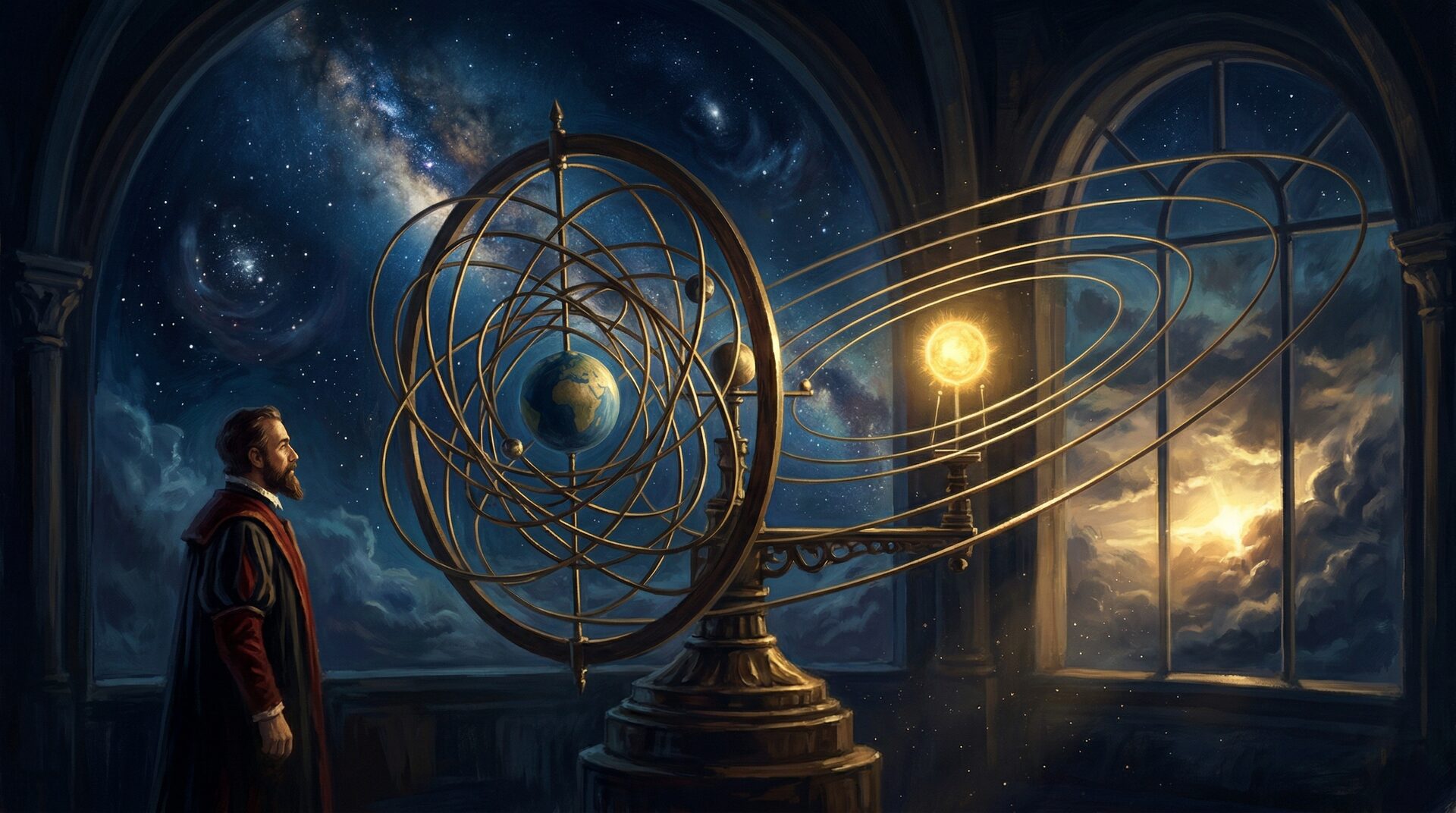
In 1543 opperde Copernicus iets radicaals: de aarde draait om de zon, niet andersom. Hij veranderde geen enkele waarneming. Hij veranderde het perspectief. Opeens stortte het ingewikkelde systeem van epicykels dat astronomen eeuwenlang nodig hadden gehad in tot eenvoudige, elegante ellipsen.
Het 7-dimensionaal raamwerk stelt een vergelijkbare kanteling voor. Al decennia worstelt de kosmologie met verschijnselen die hardnekkig elke verklaring weerstaan: donkere materie die niemand kan vinden, donkere energie die niemand kan verklaren, een lichtsnelheid die constant heet en toch tart in een heelal dat die aanname lijkt te weerspreken. Het standaardmodel werkt prachtig — tot het dat niet doet. En waar het faalt lapt het bij: nieuwe deeltjes, nieuwe constanten, nieuwe epicykels.
"We don't see it as it is, and don't know how it is — because we only perceive a 4D cross-section of a 7D reality."
Denk aan een plat vel papier. Een tweedimensionaal wezen dat op dat vel leeft zou lijnen en punten zien — nooit de diepte van de ruimte eromheen. Als je je vinger door het papier duwt, zou het 2D-wezen een cirkel zien verschijnen, groeien en verdwijnen — een mysterieus „deeltje” dat uit het niets opduikt en verdwijnt. Dat is wat wij doen wanneer we het universum in vier dimensies proberen te verklaren. We zien projecties, schaduwen, doorsneden van iets diepers. Het 7D-raamwerk vervangt de vierdimensionale natuurkunde niet; het bedt haar in een grotere ruimte waar de anomalieën vanzelfsprekend worden.
Maar dit raamwerk gaat niet alleen over quarks en sterrenstelsels. Als de werkelijkheid zeven dimensies heeft, dan geldt dat ook voor alles wat erin bestaat: economieën, samenlevingen, bewustzijn, menselijke betrekkingen. We hebben geprobeerd buitengewoon complexe sociale en technologische problemen op te lossen door slechts in twee of drie dimensies tegelijk te denken — groei tegenover gelijkheid, technologie tegenover werkgelegenheid, vrijheid tegenover veiligheid. Wat als die spanningen oplossen zodra je een stap terug doet en er zeven ziet?
Dat is de ambitie van dit raamwerk: een nieuw coördinatensysteem bieden voor begrip — van de structuur van het atoom tot de structuur van de samenleving.
Het coördinatensysteem
Elke entiteit, elk verschijnsel — van subatomair deeltje tot universum, van cel tot samenleving — wordt volledig beschreven door een punt in deze 7D-ruimte. Vier van deze dimensies zijn bekend. Drie zijn nieuw — maar zodra je ze ziet, kun je ze niet meer níet zien.
De drie ruimtelijke dimensies — breedte, hoogte, diepte. Het toneel waarop alle fysische verschijnselen zich afspelen. In het 7D-raamwerk blijven ze klassiek: je kunt vooruitlopen, opzij stappen en klimmen. Maar hun gemeten waarden — de afstand tussen sterren, de grootte van een atoom — hangen af van de lokale G-waarde. Ruimte is geen vaste achtergrond. Zij reageert op haar context.
De opeenvolging van ervaring — verleden, heden, toekomst. In het standaardmodel stroomt de tijd één kant op. In het 7D-raamwerk is de richting van de tijd niet universeel. Bij negatieve G-waarden keert de lokale tijdstroom om. Dit is geen sciencefiction; het is een rechtstreeks gevolg van de wiskunde. Het betekent dat in bepaalde gebieden van het universum — binnen zwarte gaten, aan de randen van neutronensterren — oorzaak en gevolg in tegengestelde richting lopen, met verstrekkende gevolgen voor energie, fusie, en de aard van causaliteit zelf.
De vijfde dimensie — en misschien wel de meest revolutionaire. G beschrijft de versnelling in schaal: hoe snel dingen groeien of krimpen op een bepaald punt. Zij wordt bepaald door twee factoren: het lokale Higgs-veld en de verhouding tussen donkere („zwarte”) en zichtbare („witte”) materie. Uit G komt al het overige voort: massa is evenredig met G. De lichtsnelheid hangt af van G. De richting van de tijd hangt af van het teken van G. Deze ene dimensie verklaart wat op dit moment drie afzonderlijke uitvindingen vereist: donkere materie, donkere energie, en de kosmologische constante.
De zesde dimensie is een glijdende schaal van antimaterie naar materie. Entiteiten met een andere W-waarde dan de onze zijn voor ons onzichtbaar — ze bestaan, ze oefenen zwaartekracht uit, maar we kunnen ze niet zien of aanraken. Dit is wat wij „donkere materie” noemen: geen exotisch deeltje, maar gewone materie op een andere positie op de W-as.
Maar W reikt veel verder dan de natuurkunde. In levende systemen staat W voor de kwaliteit en coherentie van een toestand — hoe constructief of destructief, hoe levensvatbaar of vervallend. Toegepast op menselijke systemen wordt W een maat voor waarde: niet financiële waarde, maar de diepere vraag of iets bijdraagt aan leven, groei en coherentie, of leidt tot entropie, verval en vernietiging. Zo wordt W de brug tussen natuurkunde en bewustzijn, tussen kosmologie en ethiek.
De zevende dimensie is de index voor meerdere universa. In het 7D-raamwerk is elk zwart gat geen doodlopende weg — het is een universum binnen een grotere structuur. Ons universum ontstond uit wat wij de „oerknal” noemen, maar dat was het inwendige van een zwart gat in een universum op een hoger niveau. N beschrijft het geheel van al die parallelle kosmische regimes, elk met zijn eigen (x,y,z,t,G,W)-configuratie.
Dit is geen speculatie — het is een structureel gevolg van het model. Materie stroomt van zwart naar wit, universa nestelen zich in universa, en de uitdijing die wij waarnemen is de natuurlijke groei van een structuur die is ingebed in iets groters. N maakt van het multiversum een coördinaat in plaats van een filosofische curiositeit.
Een andere manier van denken

Een goudvis in een ronde kom ziet de kamer door gekromd glas. Elke rechte lijn lijkt gebogen. Elke afstand wordt vervormd. De vis kan een volstrekt consistente natuurkunde van zijn gekromde wereld opbouwen — vol wetten, constanten en voorspellingen. Maar die wetten beschrijven de kom, niet de kamer.
Wij zijn die vis. Onze vierdimensionale natuurkunde is een volstrekt consistente beschrijving van hoe de 7D-werkelijkheid eruitziet vanuit onze specifieke kom. Zij werkt. Zij voorspelt. Maar zij vervormt.
Formalisering
Voor wie dieper wil gaan: de kernvergelijkingen die beschrijven hoe de zeven dimensies zich tot elkaar verhouden. Elke formule wordt gevolgd door een uitleg in gewone taal.
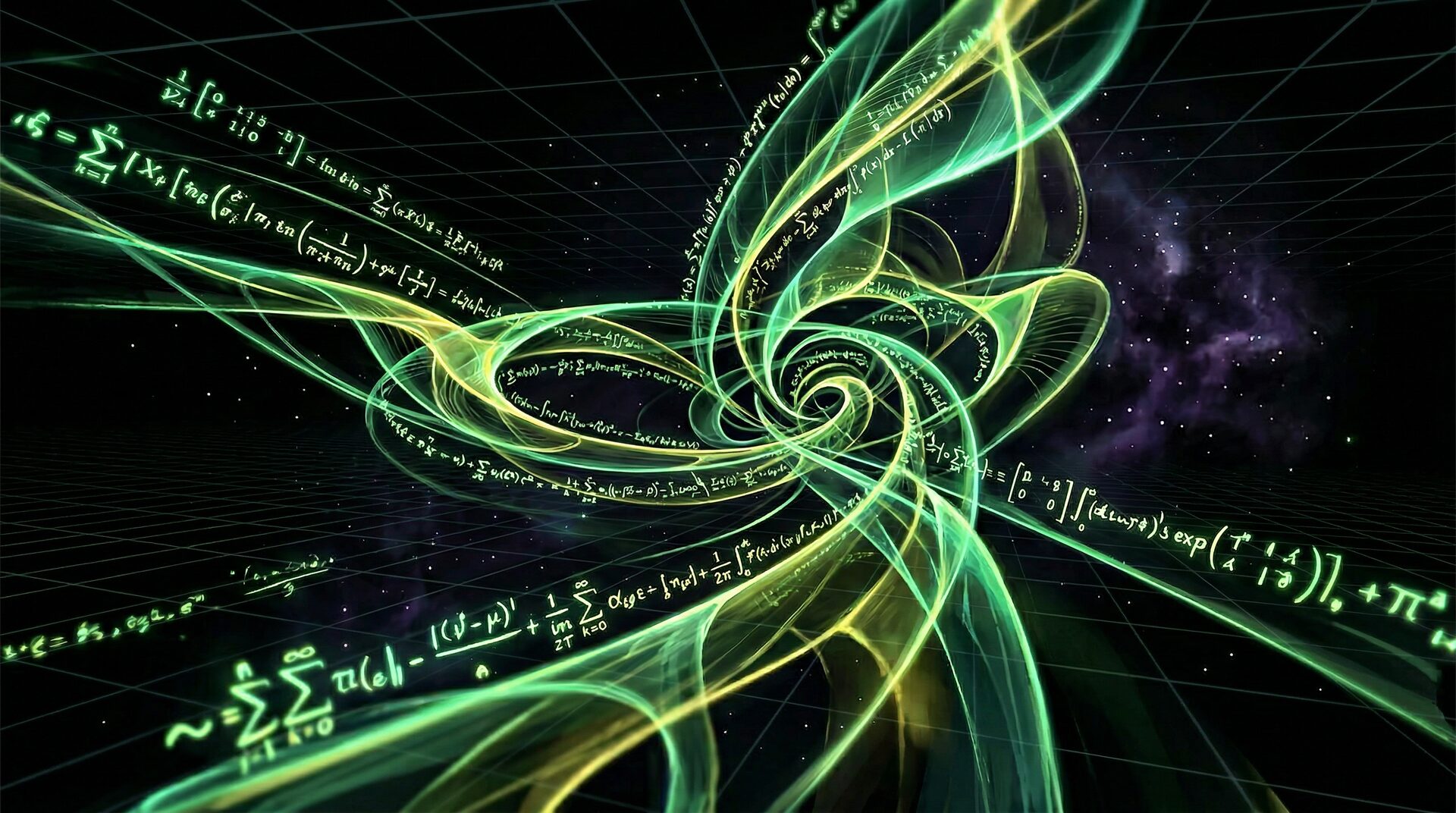
Where \(\rho_b\) is the density of black (dark) matter, \(\rho_w\) the density of white (visible) matter, \(S_0\) a reference scale, \(H\) the local Higgs field strength and \(H_0\) the vacuum expectation value. The constants \(\alpha\) and \(\beta\) weigh the two contributions.
In gewone taal: G at any point in the universe is determined by how much dark and visible matter interact there, combined with the local strength of the Higgs field. Where there is more matter interaction, G is higher — and everything downstream (mass, light speed, time flow) changes accordingly.
Effective mass is proportional to G: more local matter interaction means more mass. A rock on a mountaintop and the same rock at the bottom of the ocean are in subtly different G-regimes.
The effective speed of light varies inversely with \(\sqrt{|G|}\). In regions with high G (strong matter concentration), light travels slower. In near-empty space, it travels faster. This means our cosmic distance measurements — redshift, parallax, standard candles — are all slightly distorted by the local G-field. We have been measuring the universe with a ruler that changes length depending on where you stand.
When G becomes negative, two extraordinary things happen. First, the local flow of time reverses. Second, electromagnetic forces flip: repulsion becomes attraction, and attraction becomes repulsion.
Waarom dit ertoe doet: The Coulomb barrier is the electromagnetic repulsion between protons that makes nuclear fusion so difficult. For sixty years, we have tried to overcome it with extreme heat and pressure — brute force. In the 7D model, a locally negative G-field simply switches the sign: protons attract instead of repel. Fusion becomes not a matter of pushing harder, but of flipping the perspective.
This is the heart of the model: a metric that extends Einstein's spacetime with three extra terms. \(\ell_G\), \(\ell_W\) and \(\ell_N\) are scale-length parameters that determine the "size" of each extra dimension. Standard 4D physics emerges naturally as a projection when \(dG = dW = dN = 0\) — just as a 2D shadow on a wall is a valid but incomplete description of a 3D object.
Verkenning
Draai en verken een 7D-puntenwolk geprojecteerd in 3D. Pas de extra dimensies aan met de schuifregelaars en zie hoe ze de structuur beïnvloeden — net zoals een andere kijkhoek verschillende aspecten van een beeldhouwwerk onthult.
Natuurkunde herzien
The 7D framework does not just describe reality differently — it dissolves problems that have resisted solution for decades. Here are six areas where the new perspective offers concrete, testable alternatives.
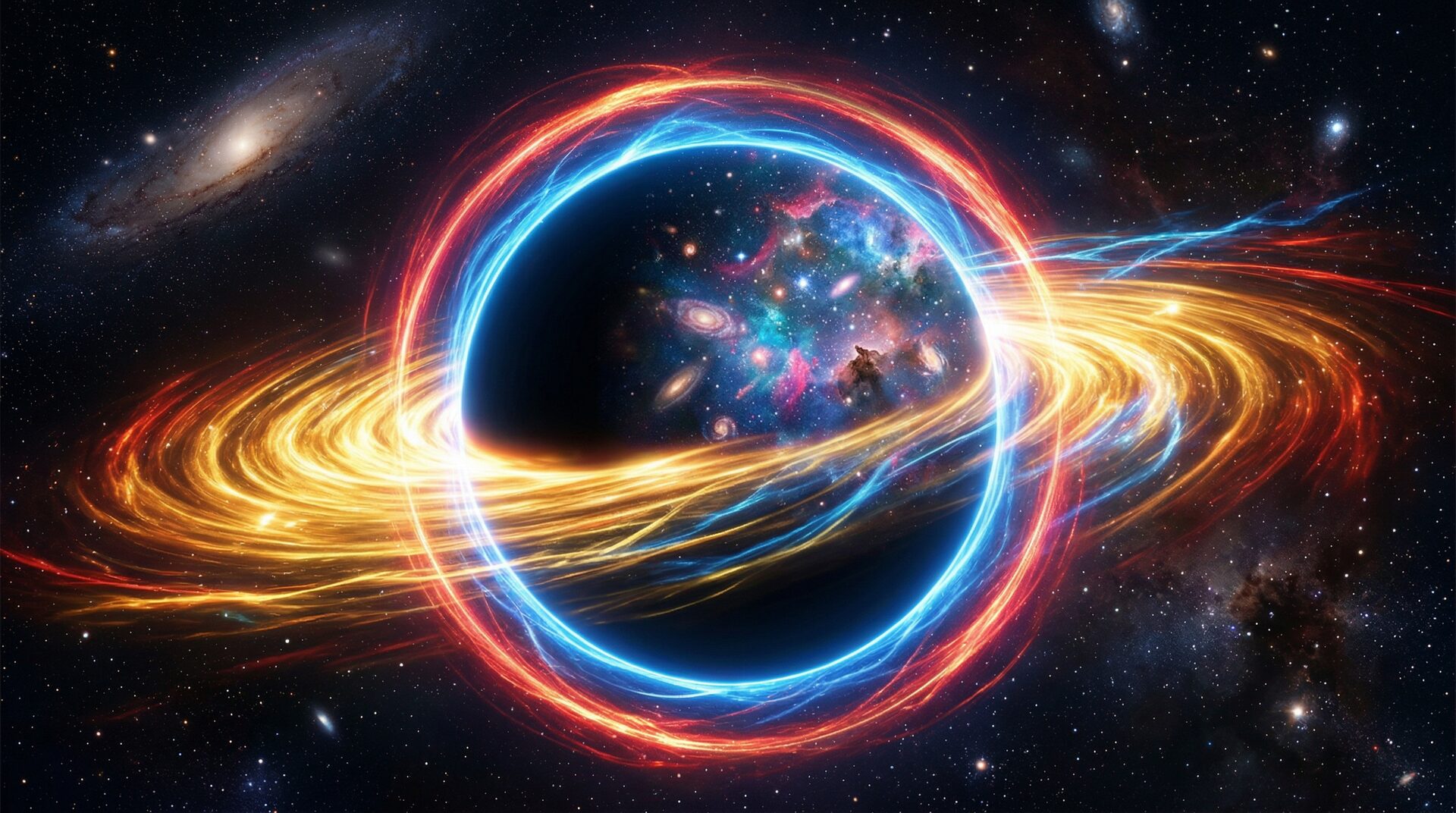
For sixty years, humanity has pursued fusion energy by trying to force hydrogen atoms together with extreme heat and pressure — temperatures exceeding 100 million degrees, confinement in magnetic bottles, billions in investment. The fundamental obstacle is the Coulomb barrier: protons repel each other, and overcoming that repulsion takes enormous energy.
The 7D model offers a radically different path. In a region where G becomes locally negative — essentially, a controlled micro-environment where the matter ratio is inverted — the Coulomb barrier doesn't need to be overcome. It flips. Protons attract instead of repel. Hydrogen becomes helium, releasing energy — not through brute force, but through a change of geometric regime.
This is conceptual, not yet engineered. But it reframes the problem entirely: instead of building bigger and hotter machines, the question becomes how to create a localised negative-G environment. A tornado in the dark matter field, a micro black hole as the combustion chamber.
In standard physics, a black hole is a singularity — a point of infinite density where the laws of physics break down. This is unsatisfying. Whenever a theory produces an infinity, it usually means the theory is incomplete, not that nature is infinite.
In the 7D framework, black holes are not singularities at all. They are regions where G passes through zero and becomes negative. Inside, time reverses, forces flip, and a new universe begins to expand — just as ours did. Every black hole is a universe. Our universe is the interior of a black hole in a higher-level structure. The "big bang" was not the beginning of everything; it was our birth within something larger.
This elegantly resolves the information paradox: information is not lost in a black hole. It passes through to the next N-level — the universe inside.
Meer dan een halve eeuw hebben natuurkundigen naar exotische deeltjes gezocht om donkere materie te verklaren. WIMPs, axionen, steriele neutrino's — geen enkele gevonden. Het 7D-raamwerk biedt een eenvoudiger antwoord: donkere materie is geen deeltje dat we nog niet hebben ontdekt. Zij is gewone materie met een andere W-waarde. Zij oefent zwaartekracht uit. Zij vormt sterrenstelsels. Maar haar licht ligt op een golflengte die wij niet kunnen waarnemen, omdat onze detectoren op onze W-doorsnede leven.
The 7D explanation is far simpler: dark matter is ordinary matter at a different position on the W-axis. It is there — it has gravity, it forms structures — but it is invisible to us because its W-value differs from ours. Like two radio stations on different frequencies: both broadcast, but you only hear the one you're tuned to. The "dark matter halo" around galaxies is simply matter in a W-shifted state, gravitationally active but electromagnetically invisible from our W-position.
The universe is expanding, and that expansion is accelerating. To explain this, cosmology introduced "dark energy" — a mysterious force that makes up 68% of the universe's content but has no known cause or mechanism. It is essentially a label for our ignorance.
In the 7D model, dark energy disappears. The apparent acceleration is a measurement artefact. Because the speed of light depends on G, and G varies across cosmic distances, our measuring tools — which all assume a constant speed of light — systematically overestimate distances in certain directions and underestimate them in others. We have been drawing the map with a ruler that stretches as we move. Correct for variable G, and the acceleration dissolves.
Einstein's special relativity assumes the speed of light is constant — the same for every observer, everywhere in the universe. This assumption has been spectacularly successful. But it may be a special case of a more general truth.
In het 7D-raamwerk is de lichtsnelheid een emergent eigenschap, geen universele constante. ceff = c0 / √|G|. In gebieden met hoge G (nabij massieve lichamen, in dichte galactische kernen) reist licht langzamer. In diepe intergalactische leegten sneller. Een eeuw lang is deze waarde constant verondersteld — en elke kosmologische meting die op die aanname berust draagt een kleine correctie in zich die stilzwijgend is genegeerd.
De W-dimensie doet wat geen enkel ander fysisch model doet: zij verbindt de fysieke wereld met het domein van de betekenis. Coherentie, kwaliteit, waarde, het leven zelf — dit zijn geen bijverschijnselen van materie. Zij zijn posities op de W-as. Voor het eerst hebben we hiermee een manier om bewustzijn en ethiek op hetzelfde coördinatensysteem te plaatsen als atomen en sterrenstelsels. Dat herleidt betekenis niet tot materie. Het onthult dat betekenis geometrie is.
A high-W state is constructive, life-promoting, organising. A low-W state is destructive, entropy-increasing, decaying. This gives us, for the first time, a way to place consciousness and ethics on the same coordinate system as atoms and galaxies. Not as metaphor, but as geometry. A society that moves toward higher W is literally — in 7D terms — moving in the same direction as matter organising into life.
Paradigmawisseling
Een directe vergelijking van hoe het standaardmodel en het 7D-raamwerk dezelfde verschijnselen interpreteren. Let op het patroon: waar 4D-natuurkunde telkens een nieuwe uitvinding nodig heeft (donkere materie, donkere energie, singulariteiten), heeft 7D-natuurkunde alleen een nieuwe dimensie nodig.
| Verschijnsel | Standaardmodel (4D) | 7D-raamwerk |
|---|---|---|
| Donkere materie | Onbekend exotisch deeltje; al 60+ jaar niet gevonden | Materie met verschoven W-waarde, gravitationeel actief maar onzichtbaar |
| Donkere energie | Kosmologische constante Λ, onverklaard | Meetartefact van variabele G en ceff |
| Zwarte gaten | Singulariteit, informatieparadox | Gebieden met G < 0, elk een universum geïndexeerd door N |
| Kernfusie | Extreme T en druk om de Coulomb-barrière te overwinnen | Lokaal negatief G-veld keert de barrière volledig om |
| Lichtsnelheid | Universele constante c | Emergent: ceff = c₀ / √|G|, contextafhankelijk |
| Massa | Alleen het Higgs-mechanisme | meff ∝ G, bepaald door zwart/wit-dichtheid + Higgs |
| Multiversum | Speculatief, niet toetsbaar | Structureel: elk zwart gat = universum, geïndexeerd door N |
| Bewustzijn | Buiten kader | W-dimensie: coherentie, waarde en kwaliteit als geometrie |
Casestudies
Phenomena that are complex or unsolved in the standard model, reduced to geometric effects in 7D. Each case shows how a single framework explains what currently requires separate, disconnected theories.
Pulsars are rapidly rotating neutron stars with magnetic fields a trillion times stronger than Earth's. They emit beams of radiation with clock-like precision — so precise that they were initially mistaken for alien signals.
In the 7D framework, pulsars sit at the edge of the G < 0 regime: matter is so compressed that G approaches zero or flickers between positive and negative. Their extreme energy output and periodic signals are oscillations around the G reversal point — like a ball bouncing on the boundary between two worlds.
The CMB is the oldest light in the universe — a faint glow from 380,000 years after the big bang, detected in every direction. It is remarkably uniform, with tiny temperature variations of just one part in 100,000.
In the 7D model, the CMB is the "shadow" of the N-dimension: a thermal equilibrium reached when matter in our universe (our specific N-index) first became transparent to photons. The small variations reflect local differences in G at that moment — seeds that would later grow into galaxies, clusters, and the cosmic web.
In 2015, LIGO detected gravitational waves for the first time — ripples in spacetime from two black holes merging 1.3 billion years ago. The signal was extraordinarily faint: a distortion of space smaller than a proton.
In the 7D model, gravitational waves propagate not only through (x,y,z,t) but also through G. They are 5D waves of which we only measure the 4D projection. This explains why they are so weak: most of the signal propagates into the G-dimension, where we have no detectors. We hear only the echo.
Galaxies rotate faster at their edges than their visible mass can explain. Since the 1970s, this has been attributed to "dark matter" — a substance that makes up 85% of all matter but has never been directly observed.
In the 7D framework, the "missing" mass is simply matter with a different W-value: gravitationally present but electromagnetically invisible from our position on the W-axis. The halo distribution follows naturally from the W-density gradient around the galaxy. No new particles needed — just a new dimension.
Voorbij de natuurkunde
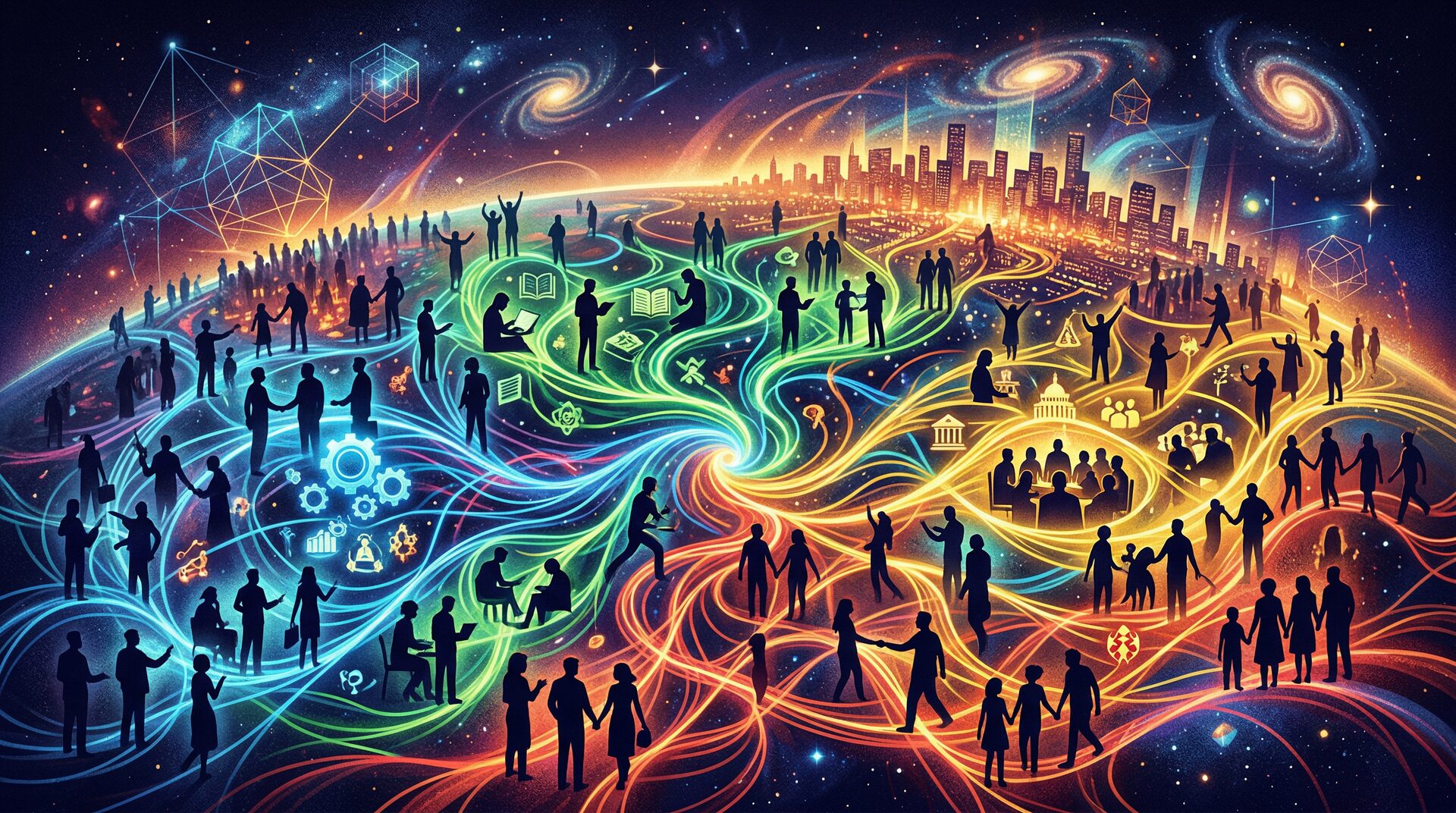
Als de werkelijkheid zeven dimensies heeft, dan hebben de systemen die wij daarbinnen bouwen ze ook. Het 7D-raamwerk biedt een nieuw coördinatensysteem om over economie, onderwijs, bestuur, technologie en menselijke verhoudingen na te denken — niet door natuurkunde te importeren in de samenleving, maar door te erkennen dat beide door dezelfde geometrie worden gevormd.
Our economic system measures success in one dimension: money. GDP counts production but not destruction. A factory that pollutes a river increases GDP. The cleanup increases it further. In a 1D economic model, this looks like growth. In a 7D model, it is a decline in W — the value dimension.
A 7D economy would measure prosperity not by volume of transactions but by net movement along the W-axis: does this activity increase coherence, sustainability, and quality of life? Or does it consume more than it creates? Money would remain a tool — but not the measuring rod. Respect, contribution, and long-term viability would become the coordinates of economic health.
This is not idealism. It is a mathematical reframing: optimising a system along one dimension always creates distortions in the others. True prosperity requires multi-dimensional optimisation.
Our education system teaches children to think in straight lines: memorise, reproduce, specialise. It is designed for a world that needed factory workers and clerks — not for one that needs creative thinkers who can navigate complex, interconnected systems.
In 7D terms, we train children to operate in two or three dimensions and then wonder why they cannot solve problems that exist in seven. A child who learns to see connections across disciplines — who understands that the principles of electricity mirror the structure of DNA, that the dynamics of a river explain the dynamics of a market — develops true intelligence. Not the ability to store facts (AI already does that better), but the ability to navigate a multi-dimensional reality.
The 7D framework suggests a fundamental revolution in how we educate: not more specialisation, but more integration. Teach children to think in coordinates, not corridors.
Modern democracy optimises along a single axis: power. Parties compete for seats, policies are designed to win elections, and the system rewards short-term thinking. Citizens are reduced to voters — a one-dimensional input into a one-dimensional system.
A 7D approach to governance would start from a different question: how do we optimise across all relevant dimensions simultaneously? Economic prosperity, social cohesion, sustainability, individual freedom, institutional trust, intergenerational responsibility, and cultural vitality are not competing priorities — they are coordinates in a multi-dimensional space.
This leads naturally to transparent, evidence-based governance: measurable goals per domain, independent citizen councils that evaluate results, and decision-making that acknowledges trade-offs instead of hiding them behind ideology.
AI is extraordinarily powerful at processing information within a defined dimensional space. It excels at pattern recognition, prediction, optimisation — within the framework it is given. But it operates without W. It has no value dimension, no sense of coherence or quality, no understanding of whether its output contributes to life or destroys it.
In a 7D society, AI becomes a tool that operates within dimensions 1 through 4 (data, processing, spatial and temporal patterns), while humans provide the G-perspective (scale and context), the W-perspective (value and ethics), and the N-perspective (alternative possibilities). AI makes humans more powerful in the dimensions it masters. Humans give AI direction in the dimensions it cannot perceive.
The danger is not AI itself — it is a society that surrenders its W-dimension to a system that does not have one.
Why does a baby feel safe with one person and not another? Why do we fall in love? Why does a room full of hostile people feel different from a room full of friends — before anyone says a word?
In 4D physics, these are "just" biochemical reactions: oxytocin, mirror neurons, pheromones. But in a 7D framework, human connection has geometry. Each person is a point in 7D space. Resonance — the feeling of connection — occurs when two configurations align across multiple dimensions simultaneously. Not just physical proximity (x,y,z), not just timing (t), but also scale of impact (G), value alignment (W), and even the possibility space they share (N).
Respect, in this model, is not a social construct. It is the recognition of another entity's full-dimensional existence. A society that reduces people to a single dimension — wealth, productivity, status — is literally diminishing their reality. A 7D society would measure respect by the degree to which it honours all dimensions of a person's being.
Plato described prisoners in a cave who could only see shadows on a wall. They built an entire understanding of reality based on those shadows — and when one prisoner escaped and saw the sun, the others did not believe him.
We are those prisoners. Our education, our institutions, our scientific paradigms are the chains that keep us facing the wall. They are not malicious — they are simply the best we could build with the dimensions we could perceive. But they are blinkers. They prevent us from seeing that the shadows are not the reality, that our 4D cross-section is not the universe, that there are dimensions we have been ignoring — not because they are hidden, but because we were never taught to look.
The 7D framework is an invitation to turn around. To leave the cave. To see the universe — and ourselves — from the other side.
Auteur
The 7-dimensional framework was developed by Jacobus van Merksteijn — engineer, entrepreneur and independent thinker. From a background in aerodynamics, materials science and coating technology grew a fascination with the fundamental structure of reality.
The core insight came from a simple observation: the most revolutionary advances in human understanding — Copernicus, Einstein, Darwin — never came from discovering new data. They came from changing the perspective on existing data. The 7D framework follows that tradition: it does not contradict the measurements of modern physics. It reinterprets them — and in doing so, dissolves contradictions that have troubled science for decades.
But this is more than a physics project. It is a framework for thinking — about energy, about consciousness, about how we organise our societies and educate our children. It is an invitation to look from the other side.
Dit raamwerk is geen voltooide theorie. Het is een richting. De hier gepresenteerde vergelijkingen zijn illustratief — de volledige formalisering is een project dat samenwerking vraagt tussen natuurkunde, wiskunde, filosofie en techniek. Als iets hiervan resoneert, en je wil meedenken, laat het gerust weten.